
Key Takeaways:
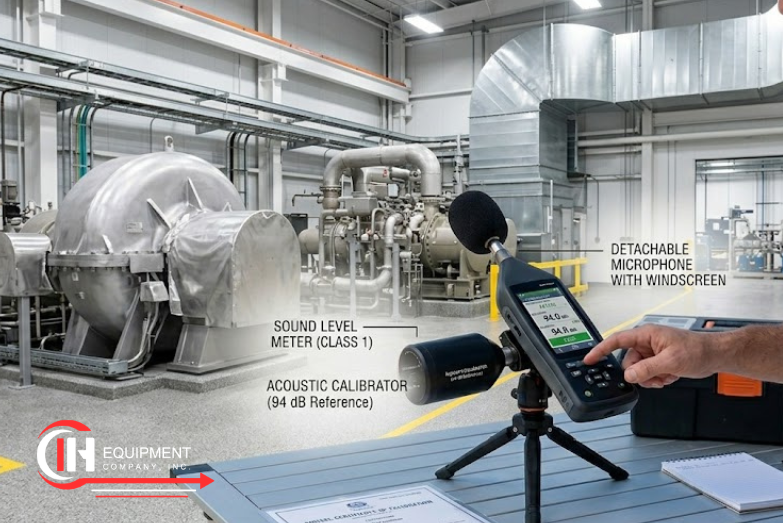
To satisfy professional sound level meter calibration requirements, you must perform a field check before and after every measurement session. A full laboratory calibration should occur every 12 months to address sensor drift and component aging.
High-precision Type 1 meters used for legal or high-stakes safety data may require more frequent laboratory verification to comply with ANSI S1.4 standards.
__________________________________________________________________________________________________
Understanding sound level meter calibration requirements is the only way to verify that your noise data stands up to scrutiny. If you collect noise measurements for OSHA compliance or environmental impact studies, your data is only as good as your last calibration.
A meter that has drifted out of tolerance can lead to incorrect exposure readings, which puts worker health at risk and leaves your organization open to legal liability.
Why do internal components drift over time?
A sound level meter is a sensitive instrument designed to measure tiny changes in air pressure. The microphone contains a thin diaphragm that reacts to sound waves. Over time, components age and the sensitivity of this diaphragm changes. Factors like physical shocks, moisture, and temperature cycles cause the electronics to shift.
Regular calibration identifies these changes and corrects them. Without this process, your meter might report a noise level of 85 decibels when the actual level is 88 decibels. In a safety setting, that three-decibel difference represents a doubling of sound energy.
This drift is often slow and invisible, making it impossible to detect without an acoustic calibrator.
What is the difference between Type 1 vs Type 2 meter accuracy?
Accuracy levels for noise instruments are defined by ANSI S1.4 standards. These standards categorize meters based on their tolerance levels across a specific frequency range.
- Type 1 Meters: These are precision-grade instruments used for laboratory work and field measurements where high accuracy is needed. They have a tighter tolerance, especially at high frequencies.
- Type 2 Meters: These are general-purpose meters used for most industrial safety applications and OSHA noise surveys. They have a wider tolerance but are sufficient for most workplace noise measurement tasks.
Regardless of the type, both require a documented unbroken chain of calibration. A Type 1 meter does not stay accurate forever just because it is a higher grade. It still requires annual calibration to confirm it meets the precision requirements of its class.
Why is field calibration different from laboratory service?
You should calibrate a sound level meter in the field using an acoustic calibrator before each use. This “field check” verifies the meter is responding correctly to a specific level and frequency. It accounts for the current environmental conditions, such as local air pressure and temperature.
However, a field check is not a substitute for a laboratory calibration. Field calibration only checks the meter at one or two points. A laboratory service performs a full calibration across the entire frequency spectrum.
The lab will test the linearity of the meter, its weighting filters (A, C, and Z), and its response to rapid noise bursts. This technical verification is performed in a controlled environment to verify the internal components are functioning within manufacturer specifications.
How often should you check noise dosimeter calibration frequency?
A noise dosimeter is a wearable sound level meter used to track personal exposure over a full shift. Because these devices are worn by workers in the middle of the action, they face more abuse than a handheld meter.
Dust, sweat, and physical impacts can quickly degrade the microphone.
The noise dosimeter calibration frequency should follow the same 12-month rule as other noise instruments. Many safety managers choose to send their dosimeters in for service every six months if they are used daily in heavy industrial environments like foundries or mines.
Regular lab visits verify that the integrated circuitry is still calculating the “dose” correctly over an eight-hour window.
How do environmental factors affect performance?
High humidity and extreme temperatures can damage the microphone capsule. If a meter is stored in a hot vehicle or used in a damp underground mine, the sensitivity will change. Exposure to high levels of dust can also coat the microphone diaphragm, adding mass and slowing its response to high-frequency sounds.
Calibration ensures that these environmental impacts are documented and corrected. If a technician finds that a meter requires a large adjustment during a lab visit, it indicates that the device may have been damaged or compromised by its working environment.
This allows you to investigate previous noise measurement data and determine if it is still valid.
Why are calibration certificates necessary?
When an inspector or auditor visits your site, they will ask for your calibration certificates. These documents provide the “Paper Trail” that proves your testing equipment is accurate. A valid certificate includes:
- The date of the service.
- The specific standards used for the test.
- The “as-found” and “as-left” data.
- A statement of NIST traceability.
Having these records for the long term is a requirement for most safety programs. If you are involved in a workers’ compensation claim related to hearing loss, these certificates are your primary evidence that your noise surveys were conducted with reliable tools.
Steps to maintain your noise measurement equipment
To keep your meters in top condition between lab visits, follow these steps:
- Use a windscreen to protect the microphone from wind noise and dust.
- Store the meter in a padded case when not in use.
- Remove batteries if the equipment will be stored for more than a month to prevent leakage.
- Avoid touching the microphone diaphragm with your fingers.
- Perform a field check with an acoustic calibrator at the start and end of every survey.
FAQs
How often should I calibrate my PID?
While this post focuses on noise, a PID (Photoionization Detector) typically needs a full calibration every six months to a year, with daily bump tests. For a sound level meter, the standard is a yearly lab calibration.
Can I calibrate a sound level meter myself?
You can perform a field calibration check using a handheld acoustic calibrator. However, a full, accredited calibration that meets ISO 17025:2017 standards must be performed in a specialized laboratory.
Does dropping the meter affect its accuracy?
Yes. The microphone is the most fragile part of the equipment. A drop can dent the diaphragm or damage internal circuits. If a meter is dropped, you should immediately check it with an acoustic calibrator. If it is out of tolerance, send it for repair.
What is the difference between ANSI and IEC standards?
ANSI S1.4 is the American standard, while IEC 61672-1 is the international standard. Most modern meters are designed to meet both. Both standards require regular calibration to verify the device stays within its assigned “class” or “type.”
How long do calibration certificates last?
Most certificates are valid for one year. Some highly regulated industries may require more frequent testing, but annual calibration is the general industry standard for industrial hygiene.
Secure Your Data with Expert Calibration
Don’t let your safety program rely on unverified data. CIH Equipment provides the precision services you need to meet all sound level meter calibration requirements. Our laboratory is accredited to ISO 17025:2017, providing you with the highest level of technical confidence and NIST-traceable documentation.
Request a Quote Today to keep your noise measurement program compliant and your workers safe.