
Key Takeaways
- What it Is: Sound and vibration calibration is the specialized laboratory testing and adjustment of acoustic and vibration measuring instruments to ensure their sensor readings are completely accurate.
- Why It Matters: Excessive noise causes irreversible hearing damage, while heavy industrial vibration can lead to hand-arm vibration syndrome (HAVS) and structural machinery failures. Accurate calibration guarantees that exposure data is reliable.
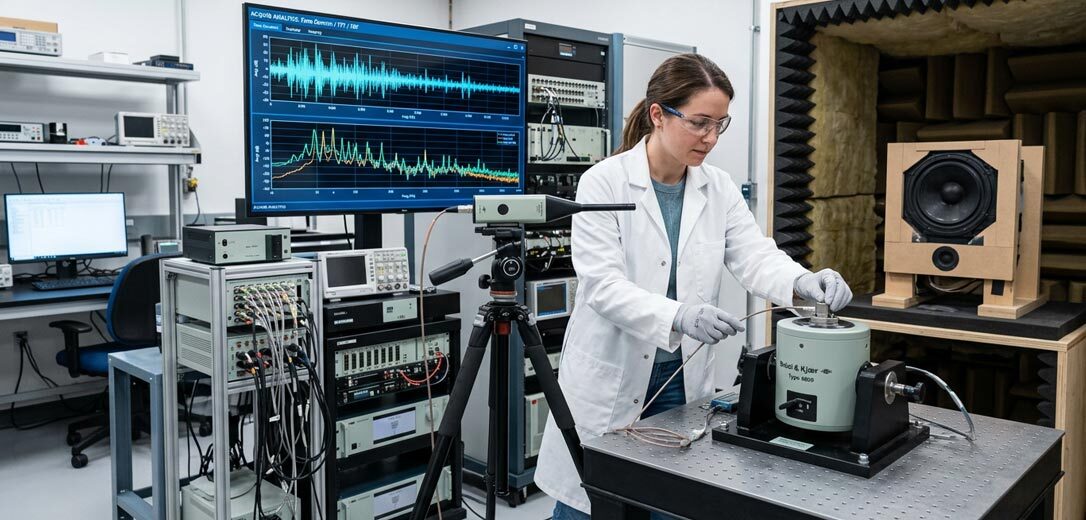
- How Vibration Tools are Tested: Precision laboratory testing relies on electrodynamic shaker tables and reference accelerometers to test sensors across a full range of frequencies and amplitudes.
- Field vs. Lab Testing: While portable vibration calibrators and acoustic calibrators are essential for quick pre-shift field checks, full servicing requires comprehensive laboratory maintenance.
- Compliance and Safety: Annual testing yields a NIST-traceable certificate, providing legal protection, regulatory compliance, and a foundation for continuous improvement in your workplace safety protocols.
_________________________________________________________________________________________________________
Understanding Sound and Vibration Calibration for Industrial Safety
In modern industrial facilities, heavy manufacturing plants, and construction sites, noise and structural motion are constant presence factors. However, when sound pressure levels exceed safe thresholds or machinery vibration passes tolerable limits, these environmental conditions transform into hazardous workplace threats.
Prolonged exposure to high decibels can cause irreversible occupational hearing loss, while excessive tool vibration can cause severe nerve and vascular damage in workers.
To protect employees and remain compliant with occupational safety regulations, safety professionals rely on specialized instruments such as sound level meters, noise dosimeters, accelerometers, and vibration meters.
Yet, these sensitive devices are frequently exposed to harsh operational conditions, extreme temperatures, and physical drops, causing their internal sensors to drift over time.
This guide covers what you need to know about sound and vibration calibration, how laboratory testing works, and why routine maintenance is essential for your workplace safety program.
Why Sound and Vibration Calibration is Essential
When environmental health and safety (EHS) managers monitor a facility, they make critical safety decisions based on the numbers displayed on their instruments.
If a sound level meter reads 82 decibels when the actual noise level is 89 decibels, workers will be exposed to hazardous sound levels without required hearing protection.
Similarly, an uncalibrated vibration meter might underestimate the acceleration transmitted to a worker’s hands from pneumatic tools.
Performing routine sound and vibration calibration resolves these risks by comparing an instrument’s readings against a known, highly precise reference standard. If the test instrument deviates from the reference standard, laboratory technicians adjust its internal hardware or software settings to bring it back into perfect alignment.
The Science Behind Vibration Instrument Testing
Vibration sensors, such as accelerometers and velocity transducers, measure physical motion across various dynamic frequencies. Over time, physical impacts and mechanical wear degrade their sensitivity.
In a professional calibration laboratory, technicians utilize specialized equipment to test these instruments:
- Shaker Tables: High-precision electrodynamic shaker tables generate controlled, uniform physical oscillations. The sensor being tested is mounted onto the shaker along with a reference sensor, allowing technicians to evaluate response accuracy across low, medium, and high frequencies.
- Vibration Calibrators: Specialized vibration calibrators supply stable acceleration and velocity signals to verify sensor output under controlled conditions.
This laboratory-grade approach ensures that your vibration meters accurately capture peak acceleration, velocity, and displacement, providing reliable data for worker health assessments and predictive machinery maintenance.
Regulatory Compliance and NIST Traceability
When OSHA or state environmental health agencies inspect a facility, they do not just look at your raw exposure data; they inspect the documentation proving your instruments were accurate when the measurements were taken.
Sending your measurement devices to a dedicated laboratory guarantees that your equipment receives a NIST-traceable calibration certificate. This documentation creates an unbroken, legal chain of measurements reaching back to national standards maintained by the National Institute of Standards and Technology.
Maintaining these records is vital if your company ever faces regulatory audits, workplace injury claims, or safety compliance reviews.
Driving Continuous Improvement in Industrial Hygiene
Routine calibration is more than a regulatory requirement; it is a key component of operational excellence. Incorporating annual laboratory servicing into your safety routine supports continuous improvement across your industrial hygiene program.
By systematically maintaining your monitoring fleet, you eliminate data ambiguity, prevent unexpected equipment downtime, and build an environment where worker health is protected by verifiable science.
FAQs About Sound and Vibration Calibration
How often should sound level meters and vibration sensors be calibrated?
Industry standards and equipment manufacturers universally recommend sending sound level meters, noise dosimeters, accelerometers, and vibration meters to an accredited laboratory for a full calibration at least once every 12 months.
What is the difference between a daily field check and laboratory calibration?
A field check is a brief single-point verification performed on-site before a shift using handheld acoustic or portable vibration calibrators.
Laboratory calibration is an exhaustive, multi-point evaluation performed by metrology technicians using precision reference standards, shaker tables, and environmental controls to adjust the instrument’s internal mechanics and issue a certified test report.
Can sensor drift occur without physical damage to the device?
Yes. Even if an instrument looks pristine on the outside, internal components drift over time due to battery fluctuations, aging electronic circuits, piezoelectric sensor degradation, and exposure to humidity or temperature swings.
Protect Your Workforce with Professional Services from CIH Equipment
Don’t leave your health and safety data to chance. Ensure your instruments deliver accurate, defensible readings every time you turn them on. CIH Equipment provides expert, high-precision laboratory calibration services for sound level meters, noise dosimeters, vibration sensors, and industrial hygiene instruments.
Our team delivers fast turnaround times, meticulous testing, and full traceability so you can maintain compliance with complete confidence.
Contact CIH Equipment today to request a service quote and keep your monitoring tools performing at their best!